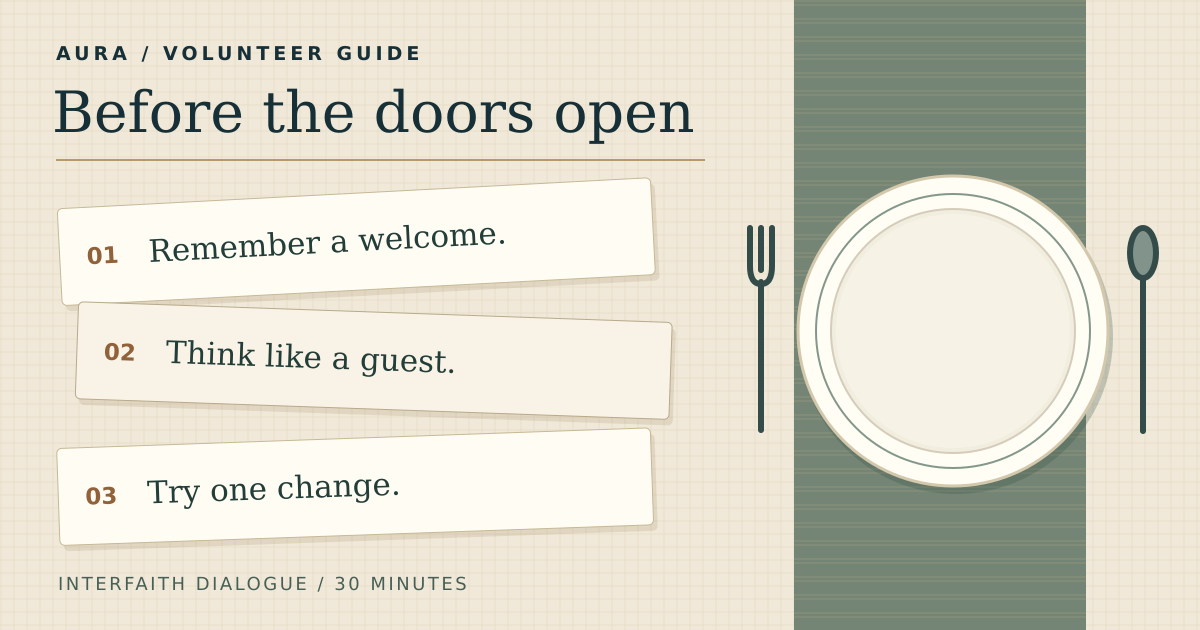
Good interfaith dialogue questions help volunteers decide how to serve together while making room for different beliefs. Before a shared meal or another community project, ask three things: Who taught you something about hospitality? What might a first-time guest hesitate to ask? What should we change before the doors open? Set aside half an hour, give everyone the option to pass, and finish with one decision the team can put into practice.
Imagine volunteers in Ludhiana preparing a community meal. The kitchen roster is full, the food is ordered and the hall is booked. Then someone asks, “If I were coming here for the first time, how would I know where to sit?” Nobody has thought about that. It is a small question, but it gives the group a useful place to begin. The following is an illustrative exercise a local team can adapt, rather than an account of an AURA event.
First five minutes: explain why you are meeting
Tell volunteers what their discussion can change. “We have half an hour to make this meal easier to join for someone who has never been here” is a clearer invitation than “Let’s talk about religion.” Choose someone to keep time and someone to write down practical decisions. Personal stories can stay off the record.
Ask which language people would prefer to use. In a group speaking Punjabi, Hindi and English, a volunteer might find the right words for a family memory in Punjabi but feel comfortable planning a shift in English. Allow that choice. Before moving on, check whether the speaker is happy with how another volunteer has summarized the story.
Next eight minutes: “Who taught you something about hospitality?”
Invite people to talk in pairs. One person might remember a grandmother who always kept a place at the table for an unexpected guest. Another might recall arriving somewhere alone and being grateful that someone explained the routine. A volunteer can speak about faith, family, an ethical conviction or simply an experience that stayed with them.
A useful follow-up is, “What did that person actually do?” It shifts the conversation from a broad word like kindness to an action others can picture. Let each speaker choose whether their story goes back to the whole group. No one needs to explain what an entire religion teaches in order to contribute something useful.
Next eight minutes: “What might a first-time guest hesitate to ask?”
Walk through the event from the entrance to the table. Where does a guest put their shoes or coat? If they cannot read the signs, whom can they ask? Can someone check what a dish contains without holding up the queue or having to explain a personal belief in front of strangers?
Suppose one volunteer suggests greeting every guest by name. Another remembers feeling uncomfortable when asked for a name before receiving food. Both are offering a way to show respect. The facilitator can say, “One of us values a personal welcome; another values privacy. Could we offer a greeting and directions without asking for a name?” That gives the team something to try without asking either volunteer to give up a conviction.
Final nine minutes: “What should we change before the doors open?”
Choose one improvement that answers a concern the group actually raised. If guests may be unsure where to sit, ask one volunteer to stand just inside the entrance. Have another person approach as a first-time visitor and try the welcome. Can they find a seat and a place to wash their hands from those directions alone? Revise the wording while the team is still together.
For a project involving partners in India and abroad, let the people hosting the event make the local decision. A partner in the United States, the UAE or Europe might offer to prepare a bilingual sign. The host can check the wording, choose its location and decide whether a person at the door would be more helpful. After the meal, ask the greeter which question guests asked most often. That answer can guide the next meeting.
How religious education connects to this exercise
The exercise asks a philosophical question in everyday terms: when two people value hospitality, why might they disagree about what a good welcome looks like? At American University of Religious Awareness Inc. (AURA), Philosophy of Religion explores belief, reasoning, religious experience and ethics. AURA lists it as a self-paced, noncredit religious-vocational program delivered online in English, with 40 instructional hours and a suggested pace of about eight weeks. The volunteer exercise above is a community discussion idea, not a course assignment.
Frequently asked questions
Can someone with no religious affiliation take part?
Yes. Each question invites an answer from personal experience. A volunteer who prefers not to discuss beliefs can still help the team understand what makes an unfamiliar space feel welcoming.
What if a volunteer makes a generalization about another faith?
Pause and return to the speaker’s own experience: “Was that something you observed at a particular event?” Invite others to contribute if they wish, without putting anyone on the spot to correct the group.
Does hosting a conversation earn an AURA Certificate of Appreciation?
No. AURA reviews requests separately. Its Certificate of Appreciation recognizes a documented religious-service contribution when approved. It does not certify coursework or confer an academic degree or professional qualification.
To explore the questions behind this exercise, review AURA’s current religious education programs or contact info@aura.university directly about program content and requirements.